After the Storm: Grief and Recovering From Trauma

Updated: Aug 31
To anyone who reads my blog, I realize I left you on a bit of a cliffhanger after sharing what happened to us at Samuel de Champlain Provincial Park on June 21, 2025. For those who are new here, we were caught in a sudden, devastating storm while camping, when two large trees fell onto our trailer, leaving one of us pinned and trapped inside for hours. I’ve shared the full story here.
Vic’s Recovery
It’s been quite a journey. Vic was admitted to the hospital in Sudbury for three weeks, after an initial week in North Bay. There were three surgeries during that time. I lived in awe for much of it, watching Vic navigate a rough sea of unknowns, enduring and pushing through excruciating pain.

Their family and friends showed up in ways that were profound and unwavering, staying as close as possible through it all. My village also stepped in to support me emotionally and to help parent my kids, while I spent most of those four weeks in hospital with my love.
One of my favourite moments happened the day after Vic’s birthday, just over two months after the incident. We were gathered in a beautiful cottage in Bonfield when the fingers on their left hand began to wiggle, ever so slightly. I bawled, admitting I hadn’t been sure I would ever see those fingers move again. Weeks passed, and the movement grew, little by little.
Today, Vic has regained a significant amount of function in their left arm and hand. That said, rehabilitation is intensive, and pain is still part of daily life. Unfortunately, it’s not over yet with another surgery on the horizon. While there are still many unknowns, things are far better than we originally feared.
Returning to Site 144
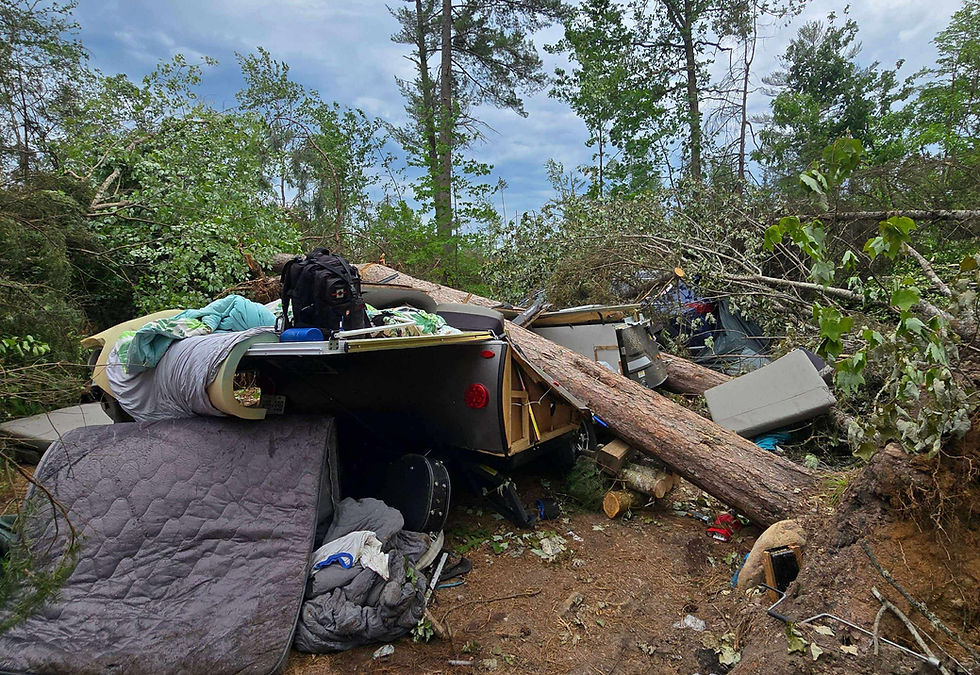
Five weeks after the incident, we finally regained access to our cars and the remains of our camping gear. The fact that it took that long to be allowed re-entry (by appointment only) speaks to the scale of the devastation. The park had become completely inhospitable, with trees down everywhere, all lying in the same direction - a pattern we later learned is a classic signature of a downburst

The original five who were in the tent trailer that night (Andy, Vic, Char, Eli, and I), along with our parents, and a couple of close family friends, all drove in what felt like a quiet procession through a graveyard of old-growth trees.

We were led to what was left of our site by the park ranger who had spent hours that night navigating over and under hundreds of fallen trees, carrying a chainsaw and a jerry can to reach us. It felt so meaningful to debrief with him and to tell him that we had been referring to him fondly as “chainsaw guy” ever since that night. He was a crucial part of the story. It was his chainsaw that finally helped release Vic’s arm from the giant pine after four and a half hours of being pinned.
The trees had been cleared off our site, so it felt quite bare. We rummaged through the debris, finding things we thought were gone for good. We also found lots of things that were damaged beyond repair. It gave me a small glimpse into what it must feel like to lose your home in a disaster and return to see what remains.

I felt a mixture of sadness and nostalgia for the moments that led up to the storm, and humility in the face of nature’s unpredictable force. There were also moments of unexpected joy in what we did find.
The biggest highlight was finding Kamila’s guitar, tucked safely under the pullout that once held the kids’ bed. I bought it for her in Kingston a year and a half before she died, after realizing she had taught herself to play in residence. The storm could easily have claimed it, so finding it felt like the greatest gift.
Vic and I returned one last time before the remains of my trailer were hauled away in mid-September. It was quieter then. We let our guards down and allowed ourselves to fully arrive in the space, with our hearts wide open.
We took it all in and marvelled at the small trees that were still standing. We sifted through the rubble and found a few more treasures, like the rocks Eli and Char had been painting moments before the storm.

After some time, we reflected on the gifts we found within the tragedy, and what we were ready to leave behind. We wrote our thoughts on small pieces of paper, shared them with each other, then rolled them into little balls and planted them in the ground like seeds on site 144 in Jingwakoki Campground.
It felt like a kind of closure, a symbolic shift from horrific chaos to something more meaningful.
The first time we returned, it felt like a wake. The second time, it felt more like a celebration of life. Both were heavy and emotional, but they gave us the opportunity to process, just a little more, what the heck happened to us that night. It felt impossible to not acknowledge the miracle that we are still alive, and how different the ending could have been.
What the Body Remembers
Beyond the medical whirlwind and returning to the site, we have also been living with the trauma of a near-death experience.
The kids are both wary of the wind now, especially storms. Well, we all are.
At first, I noticed my body flinching while driving through forests on the highway. Then I reminded myself: right, all of these trees are still standing. Many of them have been here for 80 to 120 years. The fallen trees are the exception.
I could feel my brain trying to reassure my body, attempting to convince it that it's safe. During storms, I had to set my own anxiety aside and reassure the kids. "We are safe, I promise. What happened to us was so rare.”
I had said those exact words before. Eli was only three and a half when his sister died and for a while, he ran on the assumption that Char would soon die too. "No my love, Kamila dying young was so so rare."
For a few weeks, I was focused on the narrative that I had been struck by lightning twice, and that I was not safe in the world.
How can I feel safe again when rare, unimaginable things happened to me and the kids more than once? In June??? How can any of us find comfort in the idea that the incident was 'so rare', that it would most likely never happen again?
I felt like my words no longer held any weight.
Finding Our Way Back
We are all trying to find a way to let our guards down again, with the wind moving through the trees, with lightning, and with the dreadful sound of thunder.

Camping in the forest saved my life after Kamila died, and then almost took it away, along with the people I love most. It’s an intense paradox to hold.
The traumatized part of me wants to say it’s the end of an era. But I can feel my soul quietly urging me to find my way back to camping again.
There are a few things that I learned in my grief journey that may serve me well now:
I am not in control of what happens in this precious life.
I can't prevent suffering, so I might as well let my "guard" down and pursue the things I feel called to do - even if they scare me.
If I give my grief the space it deserves and surrender to what is, my heart will lead me home.


Dear Brigitte
One of my most important laments is the Song of Bernadette Jennifer Warrens version a Leonard Cohen creation.
My near death is much slower like being hunted by a leapard that will leap at any time. I have managed to elude and taking reprieve at this time.
When I heard about Champlain and the forest the sorrow was so deep. When I drive by I don't cry anymore but I feel my heart ache. Even writing this I feel it in my body, the blood memories the ancestors bowing down to this loss of life. Sharing this has allowed me look a little into the great mystery. I will walk in ceremony with you anytime my friend.